
From motion to connected systems
A narrated video that goes from remembering that a task is finished to systems that call each other, with the chapter list and subtitles as text.
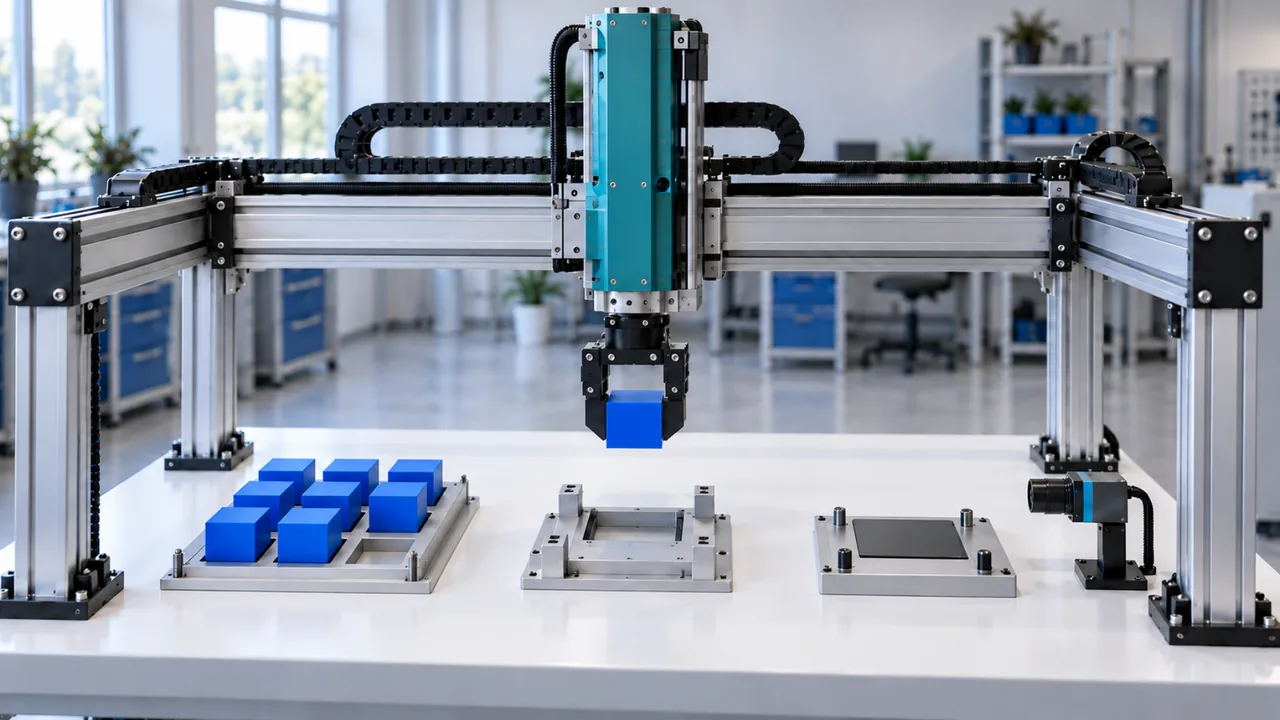
Chapters (jump directly to any section)#
Full narration transcript#
Complete subtitle text for offline reading, search, and accessibility.
- 0:02Watch how the robot places the part.
- 0:07Once the part is in place and the gripper lets go, we can mark the task as finished.
- 0:13In DS, a task is called a Work.
- 0:15A completion bit records that the task has ended.
- 0:20When the previous task is finished and the next one is ready, it can start.
- 0:25A Start arrow connects this order.
- 0:28Moving, lowering, and opening the gripper can each be a Work, with its own completion to check.
- 0:36To process the next part, we need to clear the previous completion record.
- 0:41After the part is removed, starting the removal-check Work resets the linked inspection completion.
- 0:47We add the Resets needed for each task we want to repeat.
- 0:52A System groups Works under the same control responsibility.
- 0:57A coordinates the sequence. B moves the part. C inspects it.
- 1:02B has two transfer paths: buffer to alignment, then alignment to inspection.
- 1:07The buffer has a three by three layout, holding up to nine parts.
- 1:12ApiDef defines an offered task and how completion is confirmed. B offers two transfers; C offers inspection.
- 1:20A first uses a Call inside its alignment Work to request B: pick from the buffer and place at alignment.
- 1:28After completion, the next Work calls B again: pick from alignment and place at inspection.
- 1:35Then the inspection Work calls C. Each Work in A finishes when its Call and its own completion conditions are satisfied.
- 1:45Each Call sends a command and observes completion through TAGs at both ends.
- 1:50Transfer commands go from A.OUT to B.IN. Completion returns from B.OUT to A.IN.
- 1:56Inspection signals run directly between A and C. B does not command C to inspect.
- 2:02Inspection completion and pass or fail are different information. After the operator removes the part, A checks readiness for the next cycle.
- 2:13Lowering an axis, opening the gripper and returning it empty are detailed Works inside B. They support its two product transfer paths.
- 2:22To expand the machine, add Works, connections and agreements between Systems. AAS shares standard device information.
- 2:31From one finished task to cooperation between complex Systems, the same principles carry through.