
DS Pilot for equipment control and diagnostics
Use the Dashboard to review operating signals and Equipment Doctor to look for signs of a fault. For each project, agree which PLC or PC interfaces to connect and which checks to perform during commissioning.
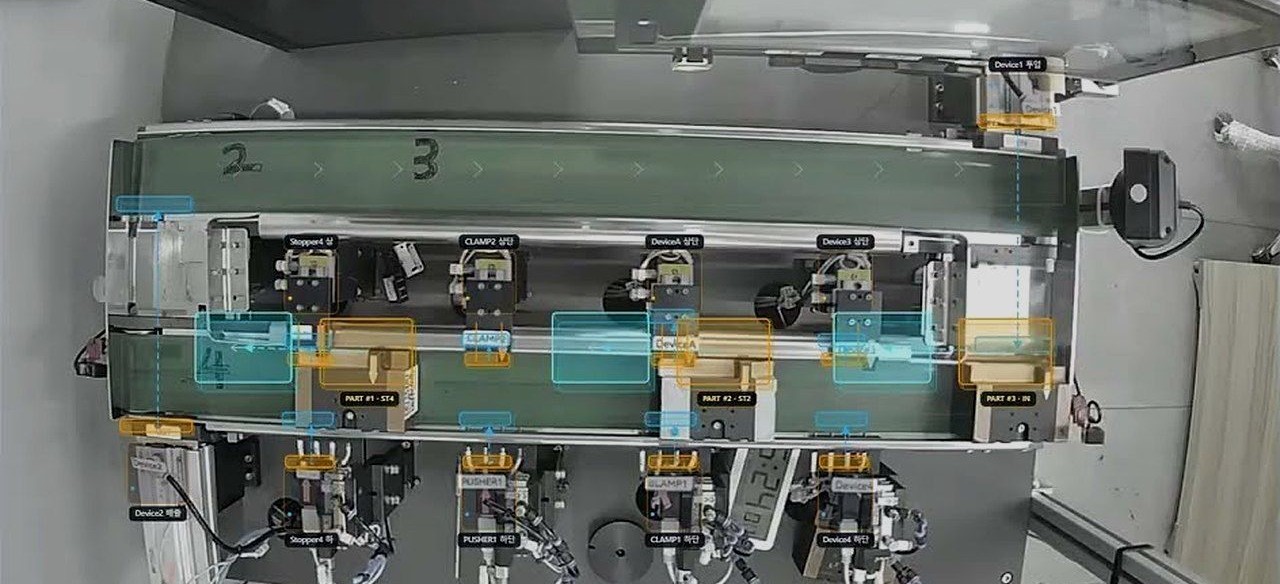
New to these factory & AAS terms? Read the quick plant guide
- AAS
- Asset Administration Shell: a standardized digital folder linking a physical machine or part to its nameplate, sequence, and 3D data.
- AASX
- A portable ZIP-based package bundling AAS submodels with attachments like 3D GLB geometry and manuals.
- Sequence
- The exact step order, interlocks, and reset conditions connecting equipment tasks (e.g., clamp before weld).
- SequenceControlData
- DualSoft's custom AAS submodel capturing flows, works, and causal links—kept explicitly distinct from official IDTA templates.
- Work
- One controllable task unit (e.g., Load, Clamp, Inspect) with its own completion state, start/reset conditions, and actions.
DS Pilot · Real Equipment Control Execution#
Define the signal boundaries and handover checks connecting authored process sequences, PLC equipment interfaces, and standard AAS repositories. Illustrative scoping example (not a customer delivery case) — Situation: aligning which start, completion, and wait conditions cross between a cell sequence and an AAS repository. Inputs to prepare: non-confidential sequence notes and signal definitions (or a pre-check first if those files are not yet organized). Scoping outcome: agreed interface boundaries, exception owners, and staged acceptance checks. Physical commissioning status: Physical commissioning outside this reference scope Not yet checked.
DS Pilot Dashboard (Observe & Understand)#
Identify which operating states, blocked interlocks, and upstream waiting conditions operators need to see when a line pauses, and agree on the equipment signals required to surface that context. Illustrative scoping example (not a customer delivery case) — Situation: operators need to see which station state or interlock is holding a paused line. Inputs to prepare: desired stop-view states and currently accessible equipment signals (starting with a data pre-check when signal access is not yet confirmed). Scoping outcome: agreed display items and required signal scope.
DS Pilot Equipment Doctor (Diagnose & Support)#
Scope which cycle-time drifts, slow transitions, and recurring fault symptoms to monitor so maintenance teams get actionable diagnostic evidence. Illustrative scoping example (not a customer delivery case) — Situation: reviewing repeated cycle delays with maintenance. Inputs to prepare: whether action-duration logs exist and under what collection conditions (starting with a pre-check if logs are not yet recorded). Scoping outcome: agreed signals and review criteria—without promising automated root-cause judgment or predictive accuracy. Vendor PLC IDE import status: Vendor PLC IDE import not executed Not yet checked.
DS Studio and AAS Reference Data#
Before scoping equipment integration, inspect 10 browser line examples in DS Studio. Review the reference mapping against IDTA AAS Specifications v3.2 (IDTA-01001 / IDTA-01002), where AASX format checks and physical commissioning stay clearly separated and SequenceControlData is documented as a DualSoft namespace distinct from official IDTA templates.
How do you find the sequence on an existing line?#
Use the wiring diagram to identify the sensors and motors. The PLC program shows what starts a motor. The operating log shows the order in which signals changed.
For example, if two motors started at the same time, check the PLC program to see whether they received the same command.
How do you compare the expected sequence with what happened?#
On an existing line, use the wiring diagram, PLC program and operating log to work out the expected sequence. On a new line, start with the sequence in the design.
If the recorded order differs, check the sensor signals and their timestamps before drawing a conclusion about the cause.
Products and their roles#
| Product | Role | Access and scoping |
|---|---|---|
| DS Pilot | Real equipment control, observation, and diagnosis | Scoped to the target environment |
| DS Studio | Control sequence authoring and 3D pre-verification | Public browser workspace |
Equipment Doctor AI standard rates#
Equipment Doctor AI collects PLC operating data and helps teams review equipment status and signs of anomalies. The rate for the contracted CPU count applies to every PLC CPU on the contract.
| Contracted PLC CPUs | Plan | Monthly rate per CPU |
|---|---|---|
| 1–4 | Basic | KRW 200,000 |
| 5–9 | Business | KRW 140,000 |
| 10 or more | Enterprise | KRW 100,000 |
On-premises deployment is quoted separately according to the site environment and project scope. Hardware, on-site implementation and additional integrations are also quoted separately when required. Business and Enterprise rates are from the October 2026 DualSoft company profile.
Three-Shadow Observation Sources (Loader, Log, Logic)#
Each source describes a different aspect of the equipment. Engineers compare declarations, recorded events and control rules before assigning meaning to a tag.
| Observation Source | Primary Question | Evidence Supplied | Single-Source Limit |
|---|---|---|---|
| Loader (Equipment declaration) | Where is it connected? (Topology) | Device boundaries, ports, and I/O mapping lists | Does not show runtime order or design intent |
| Log (Runtime event stream) | What actually happened? (Observed) | Time-series events, observed sequences, and action durations | Bounded by observation window; rare paths stay unseen |
| Logic (Control rules & DAG) | What is possible? (Rules & interlocks) | Shared command blocks, mutual exclusions, and reachable paths | Contains legacy or unused branches alongside active logic |
Conflict priority depends on the question: Observed behavior prioritizes Log; Reachable rules prioritize Logic; Physical topology prioritizes Loader. Discrepancies are surfaced as explicit Gap review items.
Reverse Mode (Brownfield) vs. Managed Mode (Greenfield) DT#
Compare recorded operations with the model used for each line.
| Dimension | Existing Factory (Reverse Mode) | New Line (Managed Mode) |
|---|---|---|
| Reference Model | Reverse Planning Model approximated from Loader, Log, and Logic | Managed Planning Model authored first (Digital-First) |
| Offline Review | Cycle-time, bottleneck, idle review, and 3D motion checks | Authoritative capacity/cycle simulation and 3D sync |
| Online Observation | Duration-deviation tracking, asynchronous twin monitoring, structured logging | Baseline-vs-actual deviation tracking, state monitoring, structured logging |
| Meaning of a Gap | Model approximation uncertainty requiring engineer verification | Difference between the design sequence and the recorded signals, for review |
Conceptual architecture overview for scoping discussions; actual controller interfaces, IDE extraction (Vendor PLC IDE import not executed Not yet checked), and physical commissioning (Physical commissioning outside this reference scope Not yet checked) are scoped per project.
Field Diagnostics Methodology & Curriculum#
Review the read-only PLC log and sequence-guided unsupervised AI diagnostic method alongside the L0–L3 shop-floor curriculum map.
Read unsupervised AI whitepaper Open field diagnostics curriculum
Like a Digital Map for Navigation: Autonomous Manufacturing Levels (L0–L5)#
Just as autonomous driving relies on a digital map and live sensors, autonomous manufacturing pairs a sealed SDF factory map for optimal route planning (Plan) with live sensor feedback and control (Action). Explore the full L0–L5 matrix and scope boundaries.
Verified Facts and Scope Boundaries#
- Physical equipment commissioningPhysical commissioning outside this reference scope Not yet checked
Physical factory wiring, commissioning, and safety acceptance are outside this software reference scope.
- PLC engineering-tool importVendor PLC IDE import not executed Not yet checked
Importing a project directly into a specific PLC vendor's engineering IDE has not yet been tested.
- Published process examples10
Interactive process-line examples published on dualsoft.ai that open without local installation.
- Referenced AAS specificationIDTA AAS Specifications v3.2 (IDTA-01001 / IDTA-01002)
The published IDTA AAS specification referenced across our migration and DPP notes.
Scope and Verification FAQ#
Why can't an existing factory's PLC program alone be completely reverse-converted into a process model?
Deployed PLC code mixes sequence, mode, fault, and manual routines while accumulating shop-floor edits, and tag names or comments decay over time. Combining three independent sources—Loader (topology), Log (observed events), and Logic (control rules)—and surfacing mismatches in a separate Gap Review Queue prevents silent guesswork.
What is the practical difference between Reverse Mode and Managed Mode in an online DT?
Reverse Mode uses a model reconstructed from equipment declarations, logs and control rules. Managed Mode uses the design model prepared for the line. Engineers compare the model with the recorded signals and check the cause of any difference on site.
Scope and deliverables are agreed together before any customer data is handled.